- News
- Reviews
- Travel & Adventure
- Interviews
- Inside Industry Players
- Community
Bikes
Reviews
Components
Reviews
Cycling
Apparel

[raw_mobile_menu]
[wpml_language_switcher_down]


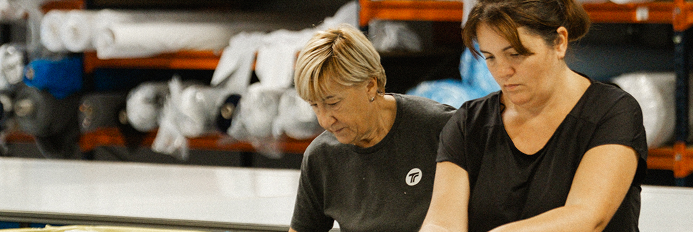
Some days ago, Franka Ramia welcomed us into her workshop in Barcelona, where she received us and talked to us about her story, her way of seeing the world, and her work. We rapidly realized that every piece she creates is unique and that she puts a bit (or a lot) of her soul into them. Franka is much more than a dressmaker; she is a cook, designer, scientist, artist, and artisan, a bunch of roles that have resulted in one-of-a-kind products.

In Italy, Franka grew up in the midst of nature surrounded by the countryside and forests. There, she discovered its purity and she had her first encounter with clothes, her mother’s closet, where she found fabrics, shapes, colors, and textures that marked her. Motivated by the dressmaking world, when she was 20 she started sewing. At first, she was self-taught but, step by step, she discovered and tried out more advanced techniques After some time she moved to Barcelona, where she opened a little shop close to the Palau de la Música. By that time she made all kinds of garments, from handkerchiefs to dresses, controlling the whole process, from acquiring the linen fabric to sewing and dyeing it.


Not yet involved in the cycling scene, in August 2016 Franka was given her first cycling kit. As she tried it, it was not what she was expecting, she got overwhelmed and felt trapped, like being cooked. If she was feeling like that, for sure, there would be more people having the same experience. Having worked with high-quality fabric, she had higher standards and she knew how to appreciate good and traditional materials.
This way, she decided to shut down her small shop of Ciutat Vella to create comfortable quality products for cyclists. She wanted to provide a material that would not pollute the environment and that was not harmful and unpleasant for the body. Besides, cycling is fashion, it is based on patterns, shapes, and colors, so she took the chance to create an attractive, as well as functional, design.


Thus, based on what she knew, she focused on the dyeing process. She went out into the woods and fields to recollect all kinds of plants, herbs, and leaves, to later use them in her workshop to create dyes and compositions on different natural fabrics. In this process, she found a way to herself and discovered her true passion. What used to be a game when she was a child was now what filled her spirit. In January 2017 she started MÃÄD, which stands for My Ancient Affairs Dyed, and symbolizes the reconnection with her young self.


Since we could see firsthand the dyeing process, we understood the subtleness of the method and Franka’s dedication to creating every single piece. Everything starts in a family workshop in Poblenou, where the jersey patterns are cut and later taken to Santa Coloma de Gramenet for sewing. After that, the garment is washed, dried, and from that moment on the magic starts.


Franka opens the jersey and lays it down on the workshop table. She has several leaves and branches that she recollected earlier in the morning and precisely places them to achieve the desired eco print. The process might seem random but it is accurate and smart. The composition is finished, she makes a wrap, ties it like salami, and places it in a big pot with the dye. It looks like as we were cooking, the workshop suddenly smells sweet.


Every dye is different, green, yellow, and brown colors are easier than red and blue. Besides, throughout the year, each plant and fruit ripens at its precise moment, which results in several palettes and plants for the ecoprint depending on the season. The plants have properties that can be transmitted to the fabric by means of the dye. Thus, MÃÄD can make you go faster or make you relaxed depending on the plants used in the dyeing process.


[sc name=”postads1″]
After half an hour she takes the jersey out of the soup, wrings it out, and opens the wrap. At first sight, the colors are very strong and the leaf shapes are clearly visible on the fabric. She hangs it out to dry and we can already distinguish the characteristic punk style of MÃÄD. The particular musette shape with the string marks in each one of her creations is there, the imperfection that brings exquisite beauty to the garment. Once it is dry, we can wash it and it will be ready to wear! But first, every single detail counts and ironing becomes an essential part of the process. Besides, since every garment is unique Franka attaches a label with its ‘birth date’ before sending it to the customer.


In MÃÄD, we will be able to find several products: short and long sleeve jerseys, an MTB shirt, or base layers. Currently, these are made out of Merino wool, but Franka also worked with bamboo and she is now experimenting with coffee viscose. The design will be totally unique, there are not two equal pieces, unlike other brands.
We were lucky to try a few garments and the sensations are hard to explain, like trying to describe colors to someone who has never seen them. The wool shirt instantly embraces you and feels like home, whereas the bamboo is fresher and smoother to the touch. Once on the bike, their properties are outstanding. When you climb and start sweating the material is perfectly breathable so that you do not get soaked but feel fresh instead and, as soon as you start descending, you instantly dry up and it brings the necessary warm comfort. Aside from the thermal properties, the fibers are antibacterial, the fabric does not smell and we will avoid adverse skin reactions. An ideal product for bikepacking, which also protects 100% from the UV sunlight in the case of vegetal fibers. Finally, if you crash and rip the fabric, the fibers can be easily patched, which translates into a durable product.


Regarding the final product, the possibilities are infinite, from the colors to the compositions. Since these are natural colors the final palette is always in harmony, everything matches, and nothing feels out of place. We can tell Franka what we want or let her surprise us. Her creations are real masterpieces that reflect her personality but always inspired by the customer. Since it is handmade there is a larger range of available sizes, therefore, we will always find the perfect fit.
The employed fabrics and dyes are natural and eco-friendly. The cut and sewing processes are local (all in Barcelona) and the transport is done by bicycle. All the dyes and materials for the eco print are obtained without any chemical process and directly from plants, vegetal waste, or minerals, which do not result in toxic waste. Thus, the environmental impact is practically non-existing.


As Franka told us, within 60 seconds, 26% of what touches your skin penetrates it. Since these are non-toxic natural fabrics and dyes, we will not have any adverse reaction, but the complete opposite.
In modern life, handmade products are not always appreciated, and the essence of the craftsman is being lost. Franka wants to pass on all her values to the garments choosing quality, local, organic, and eco-friendly products from the beginning to the end of the production of a garment. Living in Barcelona, the furthest product comes from Morocco (Henna), and she counts with a huge variety of local and foreign plants that turn out perfect for dyes and eco prints.
Her main idea is to provide a garment from which the client and the planet can benefit. This takes away from polyester and moves closer to what is natural like wool and the vegetal world. In the end, Franka cares more about the functionality and the ecological impact than the appearance, even though the designs are spectacular.
One of the latest products is a white patch with the word MÃÄD. Her idea is that you place it wherever and that you dye it as you ride. A canvas that reflects your life.


Eclipsed for having the best bicycle with the latest components, sometimes we obsess so much about the bike performance that we forget about ourselves. Feeling comfortable as we ride is more than a right bikefit, it is about the shoes, the helmet, and the cycling kit. Some years ago, Franka realized that and decided to invest all her efforts and knowledge in creating MÃÄD, a natural, eco-friendly, and organic dyeing apparel brand, visually astonishing, and above everything, so comfortable that it adapts to any situation. Because dressing, like eating and breathing, is a basic need that protects you from the outside world.

Apasionado de la bici y de la competición, Pol, siempre está preparado para una nueva aventura. Le encanta la sensación de ponerse un dorsal y es un auténtico adicto al ciclocros. Passionate about bikes and racing, Pol is always ready for a new adventure. He loves the feeling of pinning a number and he is truly addicted to cyclocross. View all posts by Pol Sopeña

 Javi Angulo

 Pol Sopeña
 Pol Sopeña
 Pol Sopeña

 Toni de la Torre

 Sergio Querpache
 Pol Sopeña
 Toni de la Torre
 Pol Sopeña
 Toni de la Torre
 Toni de la Torre
 Sergio Querpache
Hace unos días, Franka Ramia nos abrió las puertas de su taller en Barcelona, donde nos acogió y nos habló de sí, su manera de ver el mundo, y su trabajo. Pudimos ver que cada pieza que crea es única, y que vuelca en ellas un poco (o mucho) de sí. Franka es mucho más que una modista; es cocinera, diseñadora, científica, artista y artesana, un conjunto de roles que le han llevado a confeccionar un producto único.
En su Italia natal, Franka creció envuelta de naturaleza en campos y bosques. Allí descubrió su pureza y tuvo los primeros encuentros con los tejidos, el armario de su madre, donde encontró tejidos, formas, colores y texturas que le marcaron. Motivada por el mundo de la costura, con 20 años empezó a coser, primero practicando por su cuenta para, poco a poco, ir descubriendo y experimentando con técnicas más avanzadas. Al cabo de un tiempo se trasladó a Barcelona, donde abrió una pequeña tienda al lado del Palau de la Música. En esa época ya confeccionaba todo tipo de prendas, desde pañuelos a vestidos, siendo ella quien trabajaba las telas de lino, las cosía y luego teñía.
Aún no involucrada en el mundo ciclista, en agosto de 2016 a Franka le regalaron un conjunto ciclista. Al probarlo, las sensaciones no fueron las mejores, se agobió y se sintió encerrada, como si se estuviera cociendo. Si ella se sintió así, seguro que mucha más gente también. Al trabajar con telas de calidad tenía unos estándares más elevados, de modo que sabía valorar lo bueno y tradicional.
De este modo, decidió dejar su pequeña tienda de Ciutat Vella y crear un producto que fuera cómodo para el ciclista. Quería proporcionar un material que no contaminara y que no fuera dañino y desagradable para el cuerpo. Además de eso, el ciclismo también es moda, se basa en patrones, formas, y colores, tal que vio la posibilidad de realizar un diseño atractivo y único a la vez que funcional.
Así pues, se centró en el proceso de teñir. Iba a la montaña y por los campos a recolectar todo tipo de plantas, hierbas y hojas, para luego usarlas en su taller para crear tintes y composiciones sobre telas naturales. En ese proceso se reencontró a sí misma y descubrió su verdadera pasión. Lo que de pequeña para ella era un juego, ahora le llenaba el espíritu. Así, en enero de 2017 empezó MÃÄD (My Ancient Affairs Dyed, ‘mis antiguos amores teñidos’ en español).
Al poder ver en primera persona el proceso de teñir, entendimos la sutileza del método y la dedicación de Franka en crear cada una de las piezas. Todo empieza en un taller familiar de Poblenou donde cortan los patrones del maillot, que luego se llevan a Santa Coloma de Gramanet para coser. Después se lava, seca y a partir de ese momento empieza la magia.
Franka abre el maillot y lo extiende sobre la mesa del taller. Tiene varias hojas y ramas que ha cogido por la mañana y las coloca una a una en su sitio exacto para conseguir un ecoprint. El proceso parece aleatorio pero es preciso y elegante. La composición está acabada, sólo hace falta hacer un burrito, atarlo como un salami y ponerlo en un tinte de restos de comida. Parece que estemos cocinando ya que el taller de repente huele dulce.
Cada tinte es distinto. Los colores verdes, amarillos y marrones son más sencillos de plasmar que el rojo y azul. Además, durante el año cada planta o fruta madura en un tiempo concreto, por eso la paleta de colores y de plantas para el ecoprint varía en función de la estación. Las plantas tienen propiedades que conseguimos transmitir a la ropa a través del tinte. Así, MÃÄD te puede ayudar a ir más rápido o estar relajado en función de las plantas en el proceso de teñido.
[sc name=”postads1″]
Al cabo de media hora Franka saca el maillot, lo escurre y abre el ‘wrap’. A primera vista los colores son muy intensos y las formas de las hojas se han impregnado totalmente en la ropa. Lo cuelga a secar y ya podemos ver el estilo punk característico de MÃÄD. La musette que distingue cada una de sus creaciones con las marcas de los hilos es claramente visible, la ‘imperfección’ que aporta la sutil belleza a la prenda. Una vez seco lo tendremos que lavar, ¡y listo para usar! Pero antes, como que cada detalle importa, lo plancha y, además, como que cada prenda es única, Franka les pone una etiqueta personalizada con la ‘fecha de nacimiento’ antes de enviarla al cliente.
En MÃÄD podemos encontrar varios productos: maillot corto y largo, camiseta de MTB o camisetas interiores. Actualmente, estos son de lana de oveja merina, pero Franka también ha trabajado con bambú y está experimentando con viscosa de café. El diseño será totalmente único, no hay dos piezas que sean iguales, lo que caracteriza a la marca.
Tuvimos la suerte de probarnos unas cuantas piezas, y las sensaciones son difíciles de transmitir, como intentar describir los colores a alguien que nunca los ha visto. Las camisetas de lana al momento te abrazan y te transmiten cariño, mientras que el bambú es más fresco y de textura más lisa. Una vez en la bicicleta sus propiedades son excepcionales. Cuando estás subiendo y empiezas a sudar el material es totalmente transpirable de modo que no te empapas y te refrescas, al bajar te secas al momento y te abriga. Además de las propiedades térmicas, las fibras son antibacterianas, la tela no huele y evitaremos reacciones adversas en la piel. Un producto ideal para bikepacking, que además protege al 100% de los rayos UV en el caso de los tejidos vegetales. Finalmente, si te caes y desgarras la prenda, las fibras pueden fácilmente coserse, con lo que tendrás un producto duradero.
Referente al producto final las posibilidades son infinitas, desde los colores hasta las composiciones. Al ser colores de origen natural se crean patrones armoniosos donde todo combina y no desentona a la vista. Le podemos indicar a Franka como nos gustaría que fuera el acabado o dejar que ella nos sorprenda. Sus creaciones son obras de arte únicas que reflejan su persona, pero inspiradas siempre en el cliente. Al hacerse a mano, el abanico de medidas es más extenso, de modo que encontraremos siempre un tallaje perfecto.
Las telas y tintes utilizados son naturales y ecológicos. El proceso de corte y confección es local (todo en Barcelona) y el transporte se hace en bicicleta. Todos los tintes y materiales para el ecoprint se obtienen sin materiales químicos, con alternativas como plantas, restos vegetales o minerales, los cuales no generan residuos contaminantes. Así pues, el impacto ambiental es prácticamente nulo.
Como nos explica Franka, en 60 segundos te entra en el cuerpo el 26% de lo que te pones en contacto con la piel. Al ser telas y tintes naturales no tóxicos, no tendremos ninguna reacción adversa, sino todo lo contrario.
En la vida moderna no se valora el hecho de un producto confeccionado a mano, se pierde la esencia del artesano. Franka quiere transmitir todos sus valores a sus prendas optando por productos de calidad, proximidad, ecológicos y sostenibles, desde el inicio al final de la producción de la pieza. Al vivir en Barcelona, el producto más lejano proviene de Marruecos (Henna), y cuenta con una gran variedad de plantas autóctonas y otras introducidas que resultan perfectas para hacer tintes y ecoprints.
Su principal propósito es proveer una prenda que le haga bien al cliente y al planeta. Así, nos aleja del poliéster y nos acerca a lo natural como la lana y el mundo vegetal. Al final, para ella es más importante la funcionalidad y el impacto ecológico que el aspecto, aunque este sea espectacular.
Uno de sus últimos productos son unos parches blancos donde está bordado la palabra MÃÄD. Su idea es que lo coloques donde quieras y que tú mismo lo decores al pedalear. Un lienzo que refleja tu vida.
Eclipsados por tener la mejor bicicleta con los últimos componentes, a veces, nos volcamos tanto en su rendimiento que nos olvidamos de nosotros mismos. Sentirnos cómodos mientras pedaleamos va más allá de un bikefit, extendiéndose al calzado y casco pasando por la ropa. Hace unos años, Franka se dio cuenta de esto y decidió dedicar todos sus esfuerzos y conocimientos en crear MÃÄD, una marca de tintado natural y ecológico de ropa, no dañina para el medio ambiente, visualmente espectacular y, por encima de todo, tan cómoda que se adapta a cualquier situación. Porque el vestirse, como el comer y respirar, es una necesidad básica que nos protege del mundo exterior.
Apasionado de la bici y de la competición, Pol, siempre está preparado para una nueva aventura. Le encanta la sensación de ponerse un dorsal y es un auténtico adicto al ciclocros. Passionate about bikes and racing, Pol is always ready for a new adventure. He loves the feeling of pinning a number and he is truly addicted to cyclocross. View all posts by Pol Sopeña
Receive our monthly selection of the best articles, news, exclusive content and giveaways only for subscribers, subscribe to OUR NEWSLETTER
Receive our monthly selection of the best articles, news, exclusive content and giveaways only for subscribers, subscribe to OUR NEWSLETTER
Receive our monthly selection of the best articles, news, exclusive content and giveaways only for subscribers, subscribe to OUR NEWSLETTER
Receive our monthly selection of the best articles, news, exclusive content and giveaways only for subscribers, subscribe to OUR NEWSLETTER